Tracked Reverse Circulation Drilling Rigs: Solutions for Geological Sampling
Mar 13, 2026
Tracked RC (reverse circulation) drilling rigs, with their high efficiency and pollution-free sampling characteristics, are ideal tools for large-scale mineral exploration and grade control in geological prospecting. Below is a typical solution specifically designed for geological sampling. The core of this solution is to use a tracked RC reverse circulation drilling rig to quickly and economically obtain underground rock samples without core extraction, only collecting rock cuttings, for geochemical analysis to delineate ore bodies.
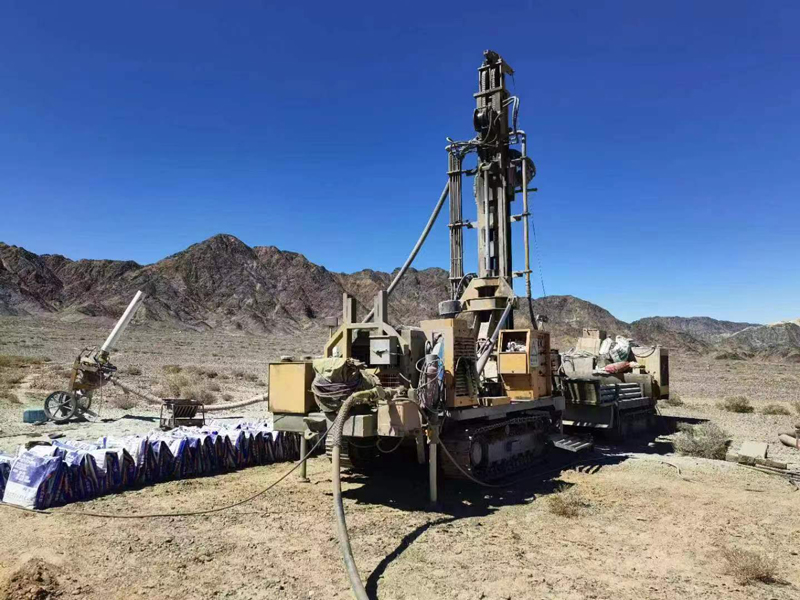
Solution Overview
This solution is suitable for rapid, continuous, and pollution-free geological drilling and sampling in overburden, bedrock fracture zones, or arid and water-scarce areas. Compared to traditional core drilling, RC drilling is extremely fast (100-150 meters per day) and can quickly obtain a large number of rock cuttings samples with precise depth correspondence. The following is a practical application of the XDL-500RC drilling rig at China Gold Group Inner Mongolia Mining Co., Ltd., used for densifying the exploration grid and precisely controlling orebody boundaries.

Core components and applications of the solution
|
Solution Module |
Specific Content and Technical Points |
Problems Solved and Advantages |
|
1. Equipment Selection |
The XDL-500 fully hydraulic crawler-type RC drilling rig is selected. Key parameters: drilling depth 500 meters, hole diameter 105-400 mm. |
High mobility: the crawler chassis adapts to complex terrain; parameter matching: ensures that the project depth and sampling volume requirements are met. |
|
2. Sampling Process |
Air Reverse Circulation (RC) Drilling: Compressed air is blown to the bottom of the hole through the annulus of the double-walled drill pipe, carrying rock cuttings back at high speed from the inner tube to the surface cyclone dust collector, where they are collected into sample bags at depth intervals (e.g., every 1 meter or 3 meters). |
Samples are uncontaminated: Rock cuttings do not contact the borehole wall, resulting in strong representativeness; extremely high efficiency: continuous drilling sampling eliminates the need for core extraction, making it several times faster than traditional methods.
|
|
3. Supporting Systems |
Large-displacement air compressor: Provides sufficient air volume and pressure (e.g., 1.7-3.5MPa); Sample collection system: Cyclone dust collector, sample separator, sample bags and labels. |
Power guarantee: Ensures effective slag removal in deep holes or complex formations; Standardized process: Enables precise sample layering and labeling for easy subsequent analysis. |
|
4. On-site Deployment |
The drilling rig moves to the hole position automatically, with hydraulic outriggers for leveling; no water source required, particularly suitable for arid and water-scarce areas; equipped with a dust removal device to reduce dust pollution. |
Rapid Deployment: Reduces auxiliary time; Environmentally Friendly: Solves exploration and environmental protection challenges in water-scarce areas. |
|
5. Data Output |
Obtain continuously distributed rock cuttings samples at depth, with sample bags labeled with borehole number and depth range. Samples are directly sent to the laboratory for elemental analysis to generate depth-grade curves. |
Guiding Exploration Decisions: Quickly delineates mineralization anomalies, upgrades resource reserves, and guides subsequent detailed exploration or mining planning. |
Solution Value and Selection Recommendations
The core value of this solution lies in its speed and accuracy: it can complete regional surveys at unprecedented speed and acquire a sufficient number of reliable data points at a lower cost, greatly reducing the risks and costs in the early stages of exploration.
Key considerations for selection:
Sampling Depth and Efficiency: Select the model based on the maximum exploration depth (e.g., XDL-220/300/500/1200RC series). Imported equipment (e.g., ROC L8) can achieve a pure drilling efficiency of 38.7 meters/hour in hard rock, while domestically produced equipment offers high cost-effectiveness.
Formation Adaptability: For aquifers and loose formations, special drilling tools such as "positive and negative cross joints" can be selected to prevent pipe blockage.
Power and Environmental Protection: Prioritize energy-saving systems such as electrical control load feedback and confirm the dust removal solution.
< Previous: None
> Next: Portable Pneumatic Down-the-Hole Drill Rig Slope Reinforcement Solution
Related Solutions
Comprehensive Application Solution of Tracked Down-the-Hole Drill Rigs in Open-Pit Mining
Addressing the need for efficient and precise drilling of various blasting holes in open-pit mining, a solution centered on an integrated, large-diameter tracked down-the-hole drill rig can effectively improve mining efficiency and slope stability.
Solutions for Fully Hydraulic Tunnel Drilling Rigs in the Mineral Resource Exploration Industry
For resource exploration in mine roadways or working areas, a solution centered on a fully hydraulic tunnel core drilling rig can overcome unique challenges such as confined space, difficult relocation, and the need for multi-angle drilling.
Get A Quote?
If you are interested in any of our products or would like to make your customized order, please feel free to contact us. We are looking forward to establish successful business relations with you.
Quick Links
Quick Links
Overssale Business
Overssale Business
Tel: +86 714 3860 269
Phone: +86 189 8659 6914
WhatsApp: +86 189 8659 6914
WeChat: +86 189 8659 6914
Email: sales@xingdamachinery.com
ADD: No 7and 8 Factory, #9 Bingang Road, Ezhou, Hubei Province, China
Get The Latest News
Get The Latest News


